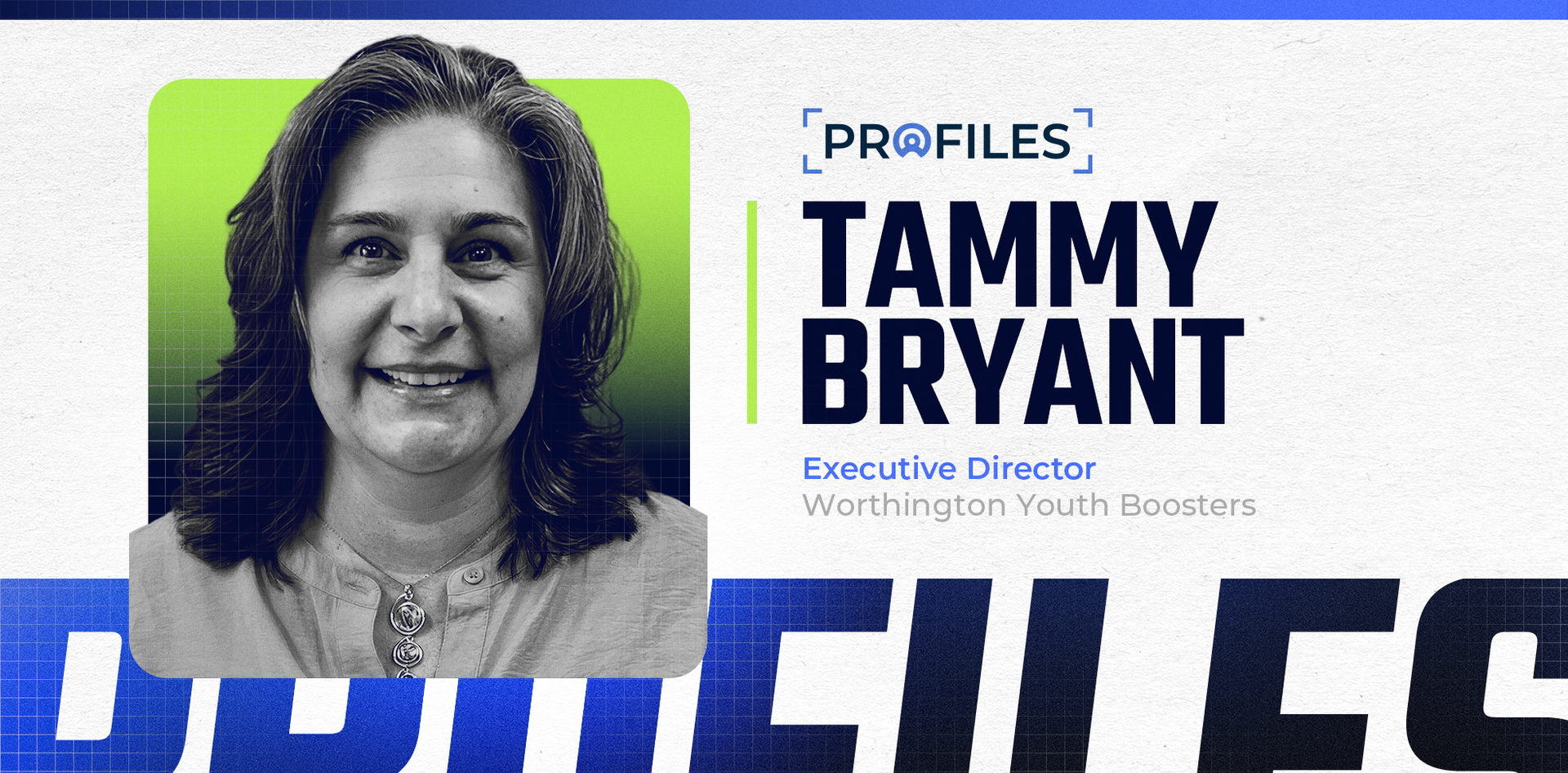
One accounting degree. Five years of learning from an inspiring female marketing director in the real estate industry. A 25-year relationship with a beloved local youth sports org, where she had 3 kids participate in a variety of sports while growing up. Run the numbers and your answer is the ideal showrunner for a 12-sport organization with 6,000 children. That’s the math behind
Worthington Youth Boosters’
Tammy Bryant.
Her story shows the many facets of being an effective leader in youth sports who can tackle demands that change by the day for the best player, family, staff, and volunteer experiences possible. In Tammy’s case, a calming presence and a someday dream of tickets to rock and roll's biggest ceremony are just as defining as her high school sports statistician days, hard-earned business credentials, and rich family life – all part of her becoming the trusted Executive Director of this longstanding Ohio institution. Toss in her growing mastery of the digital side of things, and her rockstar energy is even harder to ignore.
In this interview, she shares what Worthington Youth Boosters (WYB) has meant to her – well before she became part of the leadership team – and her pride in helping continue its tradition and impact for families, along with some advice for aspiring leaders and coaches in youth sports.
You have an accounting degree. How did you end up running a youth sports organization?
TB: My ties to Worthington go back about 25 years, when my three kids were playing here. I started as a volunteer coaching Soccer Tots, and just kept getting pulled back in. Ten years ago, I was asked if I'd want to come on full-time, and when I really thought about it, the answer was obvious. So many of my closest friendships had been formed right here. This community had already become a huge part of my life, my kids' lives, and honestly, my heart. Saying yes was easy. I've been in this role for ten years now.
Your role seems to demand a completely different skill set from your accounting background. How did you bridge that gap?
TB:
Right out of college, I went to work for a real estate company and reported to two managers: a CPA and a Marketing Director. The marketing side turned out to be the real education. The Marketing Director was one of the best leaders I've ever worked for. She was generous with her knowledge, shared it freely with everyone on staff, regardless of their background, and she always had our backs. Most importantly, she taught me to constantly ask the right questions: How do we best serve our customers? What are we giving them and what are we missing?
That mindset never left me. And it turns out, it's exactly what you need in the nonprofit world, where you wear every hat: financials, human resources, customer service, community relations. That early marketing education shaped how I approach all of it.
Tell us a bit more about Worthington – the organization represents many different sports, correct?
TB:
We offer recreation programs across 12 sports: baseball, basketball, cheerleading, field hockey, football, gymnastics, girls and boys lacrosse, soccer, softball, track and field, and volleyball. We also have travel programs in baseball, basketball, gymnastics, soccer, and softball. Supporting all of that is a team of approximately 20 directors and 40 commissioners, hundreds of coaches, and countless volunteers in additional roles.
Every day is a little different; there are success stories to celebrate and challenges to work through, and honestly, that's what makes it fun.
What does a typical day look like?
TB: No two days look the same. Some mornings, I come in to a full inbox and spend the first couple of hours just making sure everyone has what they need or is connected to the right person. The financial side is always a priority; it's what keeps us operating and serving our families. But human resources and community relations are equally important running through every week.
Over the past couple of years, WYB has made significant investments in field improvements and a new gymnastics facility, which has added new dimensions to my daily work and has been a wonderful addition for our families and the broader community.
What’s one of the most challenging experiences you’ve faced?
TB:
A great example is what happened at our gymnastics facility. When we began moving equipment to the new location, we discovered the entire subfloor had been severely damaged, something completely hidden until that moment. That meant absorbing significant unexpected costs and postponing programming for several weeks while repairs were completed.
Those are the situations that truly test a leader, when a project gets derailed by something no amount of planning could have anticipated, and you have to hold everything together anyway; communicate transparently with your sport leaders and board members, find solutions quickly, and keep the community's trust intact. It's not comfortable, but it's where I've grown the most in this role.
What part of the job takes the most mental energy?
TB:
Honestly, the customer service side can be the hardest. Sometimes families are really unhappy, and no matter how much you want to make it right, they're just not in a place to receive it. That's difficult because my instinct is always to fix it. I want their kids to participate in sports and have fun!
And then there are the high-stress stretches where my brain won't shut off. I'll wake up at 2am wondering: Did I get that budget done? Did I send that? Sometimes I have to get up and check, even when I know the answer. This morning it was 4:30 and I’m awake. So I started planning. I've actually come to appreciate those quiet hours. Nothing is crowding my mind, no interruptions, and some of my best thinking happens in those hours.
What has changed most in the industry over the years, from your perspective?
TB: I think there's been a real shift in coaching philosophy, and I believe it's for the better. Newer generations of coaches are more focused on helping kids fall in love with the sport, and that's exactly the approach we encourage at WYB. We advocate for two coaches per team, and we love it when additional volunteers can be present at practices. More positive adult voices on the field means more individual attention and a better experience for every kid.
I'm also a firm believer that coaching should never involve anything that resembles punishment, especially when we're talking about children ages 3 to 12. When my own kids were growing up, they had some tough coaches, ones who yelled, who made kids run as discipline. And what I watched happen was that the kids tuned them out entirely. They didn't learn, and some of the players stopped loving the game.
That's the opposite of what we're trying to do. Our goal isn't just to develop athletes, it's to develop kids who love being active. Because if the day comes when they can no longer play their sport, we want them to still want to move, still want to compete, still want to be part of something. That starts with making sure their earliest experiences feel safe, fun, and worth coming back to.
How do you handle decisions that not everyone will like?
TB:
You have to be able to explain decisions clearly and then give people space to digest them. Something I took from early in my career is that you can be deeply respectful of people's opinions and still lead decisively. You listen, you understand their perspective, and then you make the call. The goal is to help people understand your reasoning in a way that feels considered, not dismissive.
We also lean heavily on policy. If something has the potential to become a recurring problem, we need a policy, something tangible that people can see, read, understand, and agree to at registration. Structure is what keeps things from becoming chaos. And in an organization that serves as many families as we do, that clarity matters.

You can be deeply respectful of people's opinions and still lead decisively. You listen, you understand their perspective, and then you make the call. The goal is to help people understand your reasoning in a way that feels considered, not dismissive.
TAMMY BRYANT
Executive Director
What role does technology play in an operation this size?
TB:
We're almost fully digital at this point. All registrations are completed through our platform, the majority of our financial processes are handled digitally, and we're actively moving away from mailing checks. Technology is something WYB leans on heavily, and we're always looking for new ways to make things easier for the office and for our sports directors.
Speaking of which, our sport directors are expected to be comfortable operating in that environment. That means having reliable access to a computer and working fluency in PlayMetrics and cloud storage, including spreadsheets. It's not optional; it's how we stay coordinated across an organization this size.
And I'll say I hold my own. My kids might think otherwise, but I can navigate the tools we use and then some. Staying current with technology is part of the job, and it's one I take seriously.
What do you look for when you're developing staff?
TB: At the director level, I actually start by resending the job description. It sounds simple, but it's intentional. I want them to clearly understand that this is an administrative role, not a coaching role. Are you organized? Are you willing to do the work that happens off the field? Getting that alignment upfront saves everyone time.
From there, we work hard to be a genuine resource days, nights, and weekends. We connect directors with each other regularly so they can learn from one another, share what's working, and not feel like they're figuring it out alone. The more we invest in them, the more empowered they feel and the longer they stay.
We've had directors remain with WYB long after their own children have aged out of our programs. That kind of loyalty doesn't happen by accident. It comes from making people feel valued, supported, and part of something worth staying for.
We work hard to be a genuine resource days, nights, and weekends. We connect directors with each other regularly so they can learn from one another, share what's working, and not feel like they're figuring it out alone. The more we invest in them, the more empowered they feel and the longer they stay.
What advice would you give someone who wants to do what you do?
TB: Get a solid business foundation, an accounting or business degree, but pair it with intentional people management experience. I describe this work as a sandwich role: on one side, you have financial forecasting and board reporting, and on the other, you have customer service and staff development. Yesterday alone, I moved from payroll to project work to budget planning, sometimes within the same hour. You cannot be rigid. Flexibility isn't just helpful, it's the job.
Develop thick skin early. You're navigating a lot of different personalities every day, and not everyone is going to be happy with you. It can be a lonely place. That's why I'd strongly encourage anyone in this field to find their peer network. I'm part of a few nonprofit organizations where I can send a message and hear back from someone who has been through exactly what I'm dealing with. That kind of support is invaluable, and it's something you have to build intentionally.
And be a genuinely good listener. Be open to ideas that aren't yours. Just this year, I found myself not fully agreeing with someone in a particular direction, but they had done the research, they believed in it, and they presented it compellingly. I said, "Let's do it." That's not giving in. That's good leadership.
Finally – what do you want Worthington to mean to the families who come through here?
TB: I want them to see how deeply everyone here is invested in giving kids the best experience possible. We're always improving, and I'm not the only one driving that. Most of the programs and projects we're working on today started with a director who saw a need in the community. That's exactly the culture I want. It doesn't matter if a new idea creates more work for me; if there's interest and it serves kids we might not be reaching yet, we're going to try it. Creating new programming is honestly what excites me most. If we can serve an area we've been missing, that's a win for the kids, and that's what this is all about.
But beyond the programming, I want families to think of Worthington as the place where their child found something. Maybe it's a sport they'll play for the rest of their life. Maybe it's a coach who became a mentor. Maybe it's simply the confidence that comes from being part of a team. Youth sports don't always mean going pro – it means learning to work with others, staying focused, and discovering something you love.
We started as Cardinal Boosters in 1951. Today, we have parents coaching here who played here as kids. That continuity is rare, and it means something. They're not just volunteers – they're part of a legacy. And every child who comes through our programs has the chance to become part of it too.
We're always improving, and I'm not the only one driving that. Most of the programs and projects we're working on today started with a director who saw a need in the community. That's exactly the culture I want.
Recent Posts