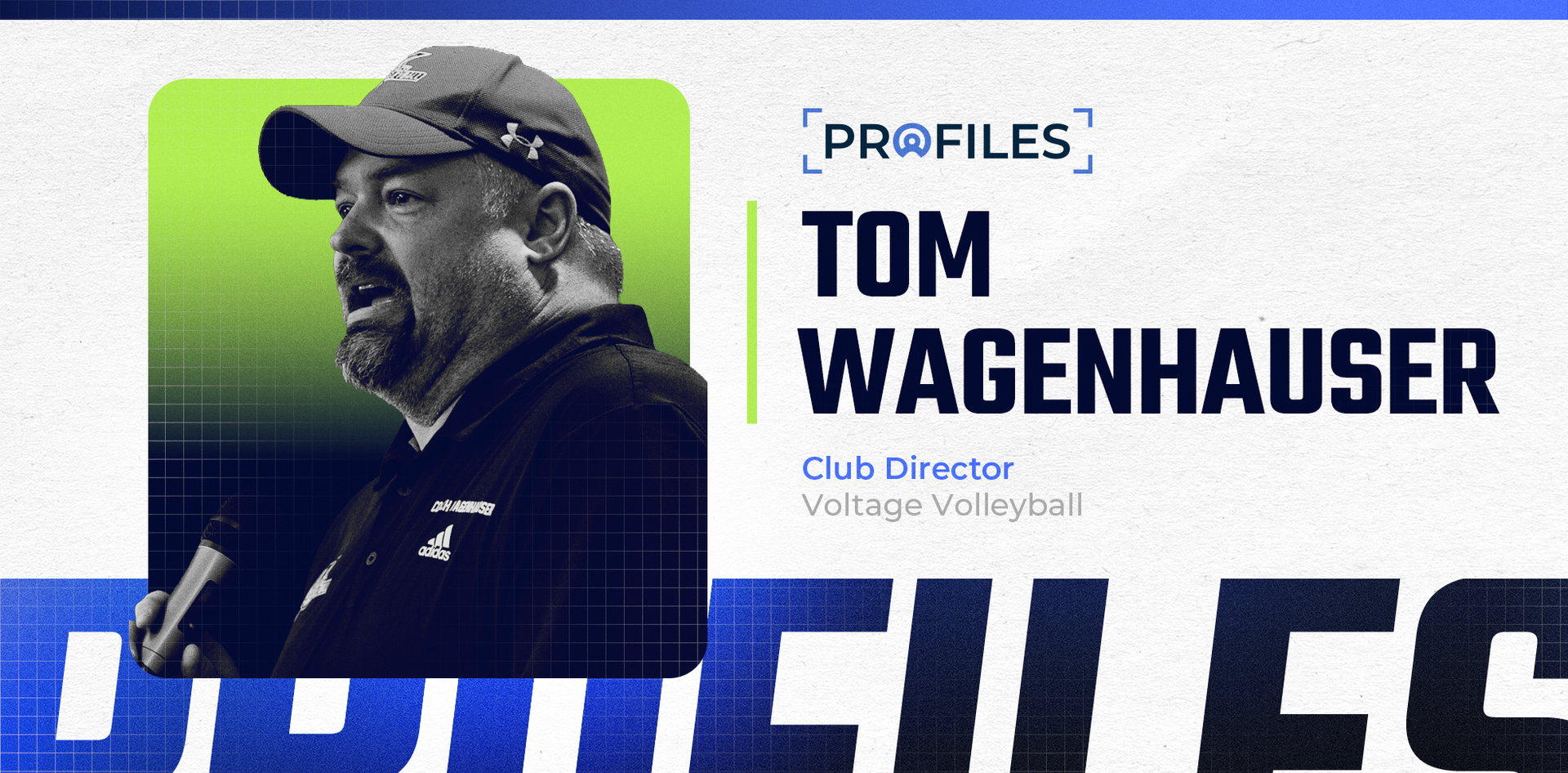
Let him cook – for
Voltage Volleyball Club Director Tom Wagenhauser, that means lasagna (his specialty), but also growing a club from the ground up and helping his players achieve things they didn’t know they could. No matter how many recipes he adds to his menu, building confidence in young people is always the main course.
He isn’t much for time off. Father and grandfather, math teacher, head coach, and business owner – plus a master’s degree in process and another grandkid on the way. But the thrills of managing a successful organization, constant learning in and out of season, and seeing kids experience the joys of hard work paying off give him the spark to do it all. That, along with the love of feeding his family, friends, and community, including the recent treat of home-smoked bacon. (Are we invited?)
In this interview, Tom shares the hardships and major lessons that layer his story, and his hopes for the game and future leaders who will define it. Dinner is ready when it’s ready.
You just took your teams to Nationals – how’d it go?
TW:
The energy is always very high at
AAU Nationals. You're talking 150 to 200 courts going simultaneously from 7:30 in the morning until 10 at night – it's really electric and our players have a great time. Exhausted at the end, but a good kind of exhaustion.
This year some of our teams unfortunately got put into higher divisions than we're accustomed to because of the registration site crashing on Cyber Monday. I reached out to the players and said, “It’s going to be a hard division, but do you want to go for it?” They were on board, and we made the best of it. The energy was still there.
Our 17- to 18-year-old boys team ended up winning their division. About two-thirds of that team were seniors who had just graduated and this was the last thing they were doing. Sending them off with that was special.
Take us back to your start as a volunteer coach for your daughter’s team.
TW:
We relocated to Florida after I sold my IT company in 2016. Bought a restaurant, then learned very quickly that I hated the restaurant industry. While this was happening, we got our daughter enrolled in school and wanted her to try sports, so we reached out to our local YMCA. We tried basketball; it wasn't really her thing. Then we tried volleyball and she took to it. They needed volunteer coaches, and I had played some quasi-competitive two-man beach volleyball and recreational six-person, and also had a history in tennis which has some similar movements. Decided to give it a shot.
Anything that I do, I go all in. I'm a lifelong learner, and have always been really good at the teaching aspect – looking at someone’s mechanics and helping them develop. We started winning a lot, including some championships, and I began receiving requests to coach.
When did you decide to start your own organization?
TW:
I had some other school coaching gigs – JV, then varsity, then ultimately head coach at Southeast Christian College. At some point I took my daughter to a clinic in Tampa and met a gentleman who owned a club. We partnered up to run his second location, but then he closed his business after that year and never paid me or fulfilled our contract. He also skated on the last payment to our rental facility, which I had to pay out of pocket. On top of all that he took quite a bit of money from players and left me on the hook – $5,000 in fees I paid myself when I hadn't collected a dime.
I said to myself, “I can do this better.” I knew the aspects of running a business. I just needed to surround myself with quality coaches.
What did you know you wanted to do differently at Voltage?
TW:
Making sure we hire and keep the right coaches; that’s where my “slow to hire, quick to fire" philosophy came in. For example, I’ll quickly replace coaches who have a power trip mentality. Sometimes you won’t see it until you work with them. We had a coach tell his girls they needed to arrive before him so they were there to greet him as he arrived. That doesn't fit our culture. At my IT company we ran a personality profile on our employees and we'll probably start that here. It’s not just about dominance, but also helping develop players and being a good nurturer.
Another big club culture thing is that we don't do negative chants toward other teams. A lot of coaches are okay with that, some actually promote it. But I've always felt our chants should celebrate our wins and the things we're doing right, not the mistakes of others.
What’s another difficult coaching situation and how did you handle it?
TW:
There was a younger coach we pulled away from a team because parents started to question certain aspects of their coaching. When you start to lose the parents it's very hard to come back from that, so sometimes we have to step back. A great coach can struggle with handling certain situations and those are things that just need to be trained. We're not giving up on that coach.
Another coach had several concerning qualities. She saw parents start a physical altercation and didn’t disclose it to us immediately. And she would regularly start negative chants in games, even when playing another team within the club. We let that person go midseason. Blame got thrown at me, and accusations that weren't true. We held a parent meeting, and a lot of her team decided to leave with her, and then started throwing stuff on social media. I told my players, “Don’t engage with it, just let it go, it'll eventually go away.”

A great coach can struggle with handling certain situations, and those are things that just need to be trained. We're not giving up on that coach.
TOM WAGENHAUSER
Club Director
That’s a lot to have on your shoulders as an owner.
TW: Yeah, it’s the hardest part for me. I put my heart and soul into this, so when people post half-truths after only hearing one side, it hurts. But engaging is going to create more problems. My wife has said, “Just like you tell our kids, wait 24 hours.” After that, if you still want to send the email or post on social media, then do it – but 99% of the time you end up never sending it because it's not going to change their perspective or fix anything.
How have parent expectations changed over the years?
TW:
Going from recreational to club coaching is a very different experience. At the recreational level, some parents have unreal expectations. They watch their kids popcorn the ball around and are sure they’re going to be D1 – then they go to play club and see how challenging it is. Even when parents are willing to do whatever it takes, sometimes there are just too many limitations and it’s a hard truth that takes them a while to realize.
You also get parents who believe paying the fee means their child deserves equal play time. They don't understand rotations, and they’ll ask, “Why is my kid only playing front row?” Well, she's a middle and she's not a great server. You have to reset expectations when a player comes in from a recreational league. We’re here to win, and you’ve got to earn your time. But we’ll always try to get them in, especially when we’re traveling, so they have opportunities to play.
We’ve had to let players go because of parents, and the bad attitude or entitlement they played a role in. It’s not what they're doing or saying at the games. It’s after the games are over. The kid gets in the car and the parents say, “You were great, everyone else around you sucks.” Then you start to see behavior in the child worsen. They end up going somewhere else because they think it’s a club problem, and it’s their fourth or fifth club. When does it start being the player?
You’ve grown from four teams to sixteen in just over four years – what’s been the largest hurdle?
TW:
Getting quality coaches in our area. There's a lot of draw from larger clubs in metro areas, and we're rural suburbia, so that's been one roadblock. This year we're refocusing a bit and slowing our growth to prioritize quality coaching, teams, and players. We’re also reintroducing breakout sessions for specific skills which we lost sight of last year. I don't want to grow just to grow. I want something sustainable.
I don't want to grow just to grow. I want something sustainable.
What are tricky parts of the job you’ve gotten a real hold of?
TW:
There were a lot of moving parts in parent engagement. One software application for the website and offer letters, one for payments, one for invoices, spreadsheets to track payments and balances, a tool for club communications, and a tool for group texting to let parents know something’s posted in the other platform. It was too much.
With PlayMetrics we started using the tryout rating feature, so as kids came in, we used the iPad, took a picture, assigned them a number, and did our ratings on tablets. Then right from the tryouts we made team assignments, and automatically sent invites where they could sign their contract, pay their deposit, and set up their payments. Then we started using it for parental communications and automated court scheduling. It groups pretty much all the things I was doing in separate applications. Saves me a lot of time.
What’s your time breakdown on an average week?
TW:
Well, I work a full-time job outside of running Voltage, and I'm working on my master's degree. Out of season, I'm probably spending 30 to 50% on administrative tasks and financials, and the other half communicating with parents and potential players then marketing on social media. In season, it's probably 60% coaching, and 40% administrative, communications, and marketing.
What’s something about coaching or directing you would tell others thinking about doing the same?
TW:
Don’t do it for the money. Coaching youth sports is about the impact you can make on players. You’re going to be a mentor, a leader, somebody they look back on later in life and appreciate what you taught them. There are some larger clubs that do well financially, but there are maybe only a handful of employees out there who are full time and not contract. If you go into high school coaching, it’s probably a stipend you’re getting at the end of the year – the last high school I was at, ended up being something around $3.12 an hour after I calculated it. You gotta love what you’re doing; love coaching, love the game.
Don’t do it for the money. Coaching youth sports is about the impact you can make on players. You’re going to be a mentor, a leader, somebody they look back on later in life and appreciate what you taught them.
Your daughter is now helping you coach at Voltage?
TW: Yep. She had a couple offers from schools to come on as a player, but started dealing with shoulder issues. Instead of trying to rehab, she decided it was the right time to stop playing, and said, “Dad, I want to coach.” She’s now working with our Littles program, and they absolutely adore her and her energy. Having her around has been a lot of fun; still young and learning, but does a phenomenal job.
What’s something you believe about running a youth sports organization that your peers may not agree with?
TW:
A lot of clubs aren't transparent. I see clubs using their lower-level teams’ finances to support their higher-level teams, which receive more coaching and attention. And communication is lacking across the board. Too many times I hear of clubs where coaches communicate to players, players are expected to update parents, and nobody knows what's going on. That's when mistakes happen.
When I was running my IT business, our motto was to be the best communicators in an industry where people are notorious for not wanting to communicate. I've taken that philosophy into every business since. I tell my parents, “You're probably going to get sick of how much I'm communicating to you.” And PlayMetrics helps me communicate with families in a multitude of ways.
How do you feel about the direction youth volleyball is heading?
TW:
I like some of the recent rule changes that help promote playing, like on the double-contact rule. When you are teaching younger players how to set, they make mistakes and in competitions they would get fouled for it, which forces them to stop doing what they were trained on and doubt themselves or start bump setting. Now we took that out. Those kinds of changes are really positive for the sport and help build confidence.
For downsides, I don't like that clubs are doing tryouts while Nationals are going on or immediately after. There's a high-pressure sales aspect to tryouts and offers – if you don't accept within 24 hours, the spot may not be yours. Parents feel obligation and anxiety about registering. I'd rather there be a set window that everybody's allowed to have tryouts.
On a difficult week, what helps you stay motivated?
TW:
Just seeing the kids. That's really what it comes down to – seeing them play, have fun, work hard and play hard. Those are the things that make it all worth it. Like I said, this isn't for money, and it's also not for the glory. If you win, that's great, but it's temporary.
If I'm working with a girl and she comes to me and says, “I've never gotten my serve over, I don't feel confident.” Then we work and work at it, she gets it over, and you see them smile and say, “I can do this.” That's the payoff right there: seeing kids do something they never thought they could do.
That's the payoff right there: seeing kids do something they never thought they could do.
How do you recharge when the job gets heavy?
TW:
Cooking is my go-to. I'm a big fan of making lasagna. I also make a great chicken parmesan. I've got all the gadgets – the sous vide, the air fryers, the instant pot. Last night a buddy and I learned how to make our own bacon; you let it cure for 10 days and then you smoke it. I've got a smoker, so I do a lot of pulled pork as well. I do some pretty good Mexican dishes, too. It all depends on who we're feeding and entertaining.
When you cook, you've got to be focused – on the recipe, on cutting, prepping, sautéing and putting it all together. It takes your mind away from literally everything. You're not going to think about the problems of the day while you're cutting that onion.
What’s the biggest thing volleyball has taught you that has nothing to do with volleyball?
TW:
Hiding how upset I am over something. I’m still working on it. From my volunteer days until now, I'm calmer on the court than I used to be. Part of being a referee myself is when there’s a referee I don't agree with and want to vocalize it. I've had my fair share of yellow cards.
What's your proudest moment so far since starting Voltage?
TW:
Last year, my 14-year-olds went into Nationals in the top 25th percentile nationally. We went 2-1, 2-1, 2-1, and had a playoff to get into gold. We lost that playoff, but we kept winning until the last match and finished 18th out of 196 teams. That was phenomenal. My girls were outsized in that last match but gave them a fight. I told them size isn't always everything – it's how you play the game. You play it smarter, you play it better. They got over the intimidation and said “We can do this.”
Recent Posts